TEL:020-82385579
粤ICP备19146443号
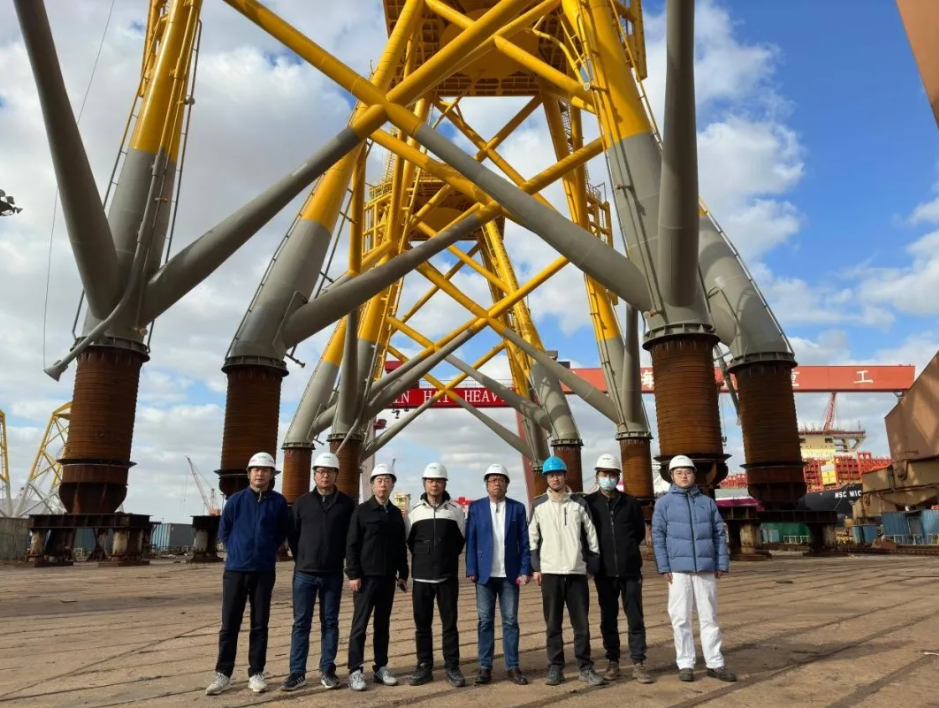
Recently, with the 800-ton gantry crane precisely positioning the 250-ton transition section, the second batch of jacket foundations for the Xiapu offshore wind power project has been successfully completed. The jacket foundation lifted this time features an opening dimension of 30 meters by 30 meters, a height of 50 meters, and a single weight of approximately 1,580 tons. The successful assembly of these foundations marks a new breakthrough for the Zhoushan base in the field of large-scale jacket foundation construction.
The project centers on lean management to solve production challenges. Since October, the base’s final assembly area has been under intense resource pressure, causing bottlenecks in processes such as sub-assembly and vertical assembly. The technical team has put the lean philosophy into practice by streamlining process handover points and innovatively introducing a “space optimization + timing control” model. Within the limited space, they’ve planned continuous work areas and reduced idle time through interweaving processes, thus creating critical windows for production. In response to delivery pressures, they’ve implemented a “people rest, machines don’t” strategy, simultaneously optimizing team configurations and breaking down the final assembly milestones down to daily targets, ensuring that progress remains fully controllable.
In terms of quality control, the team has established a lean closed-loop system. During the final assembly stage, technical and quality personnel use total stations to verify precision and optimize assembly deviations. In coating operations, the team has set up a mechanism of 'problem identification—time-limited rectification—verification and closure,' implementing full-process on-site supervision to ensure zero unresolved quality issues. Regarding production safety, the team conducts special inspections every week, with particular focus on monitoring high-risk areas such as foundation load-bearing capacity and高空作业. During windy weather, dynamic monitoring of lifting operations is activated to ensure that production safety remains under strict control.
Process innovation has become a key driver for lean efficiency improvements. Faced with disruptions caused by strong winds, leading Party member technical experts took the lead in tackling challenges, collaborating with partner units to transform on-site improvement points into innovative solutions, adopting the 'pre-fabrication and integrated lifting' process. This process maximizes the scale of prefabrication work on the ground, significantly reducing the amount of high-altitude work and the number of lifting operations. As a result, construction accuracy has been enhanced, and the project schedule, which had been delayed by weather conditions, has been successfully recovered, demonstrating the cost-saving and efficiency-enhancing value of lean production.
Currently, the first batch of jacket structures for the project has successfully passed the joint pre-acceptance by the four parties, and the second batch has been smoothly completed, officially transitioning into the acceptance and delivery phase. As the first wind power jacket structure project at the Zhoushan base, the project’s accumulated lean construction experience has set a benchmark for large-scale steel structure manufacturing. Going forward, the team will continue to deepen lean management practices, uphold stringent quality standards, and rigorously meet delivery deadlines, thereby laying a solid foundation for the company’s strategic positioning in high-end marine equipment manufacturing.